Press Release No. : 32/2026
Date : 25 November 2026
STATEMENT BY THE CHAIRMAN OF THE MACROECONOMIC COMMITTEE (MC)[1] AND GOVERNOR OF THE RESERVE BANK OF FIJI
REVISIONS TO THE MACROECONOMIC PROJECTIONS FOR THE FIJIAN ECONOMY (2026-2029)
Fiji’s economy has demonstrated resilience in 2026, despite a more challenging operating environment. The prolonged global fuel crisis has continued to place upward pressure on fuel, transportation and production costs, while El Niño conditions emerged during the second half of the year, increasingly affecting weather-sensitive sectors and raising concerns over livelihoods, agricultural production, water availability and hydropower generation.
Notwithstanding these challenges, economic activity has remained stronger than anticipated, supported by robust tourism activity, resilient domestic demand and continued investment.
Tourism has continued to perform strongly, with visitor arrivals increasing by 4.0 percent cumulative to October. This outcome has been supported by travel demand from Fiji’s key source markets, particularly Australia, improved air connectivity and a shift by travellers towards shorter-haul travel destinations since the onset of the global fuel crisis in February 2026, as higher airfares and ongoing geopolitical uncertainties have affected long-haul travel decisions. Based on current arrival trends, forward-flight and accommodation bookings, visitor arrivals are estimated to increase by 3.5 percent this year and surpass one million by year-end.[2]
Beyond tourism, economic activity has also benefitted from higher incomes, remittances and government spending, alongside increased investment, evidenced by stronger construction activity, building approvals and bank lending. The Reserve Bank’s latest Business Expectations survey points to an improvement in business conditions relative to the February survey, although it is now marginally negative on a net basis. Despite this, businesses continue to report positive investment intentions over the next 6 to 12 months. This is consistent with stronger retail trade activity, with retailers expecting sales growth of 6.8 percent in 2026 in the August survey, up from 2.0 percent in February. However, part of this improvement is attributed to higher prices alongside growth in underlying sales activity.
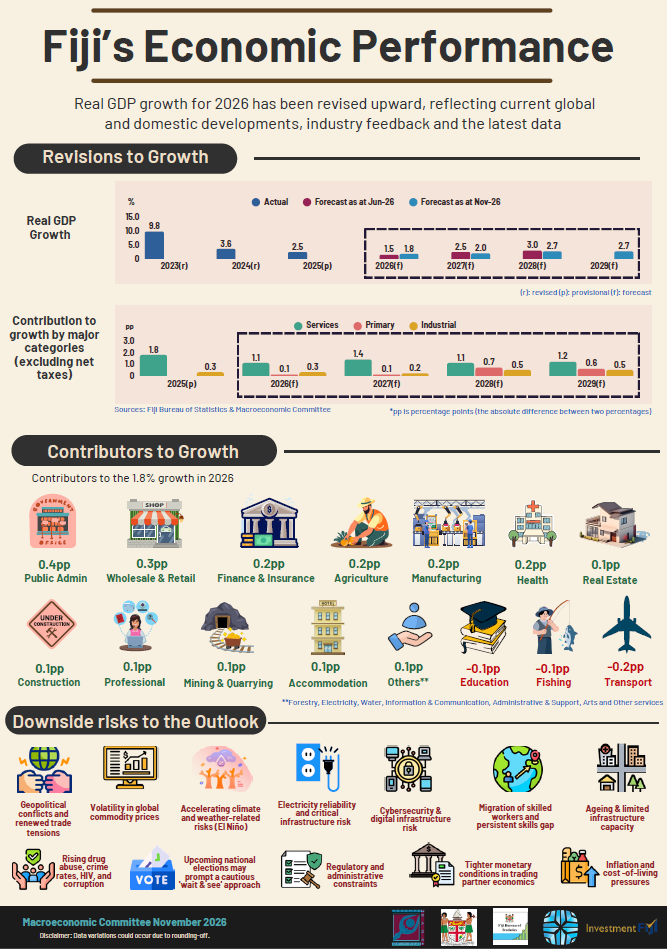
In light of these developments, Fiji’s 2026 growth outlook has been revised upward to 1.8 percent from 1.5 percent in the MC’s June assessment. The upward revision largely stems from stronger-than-anticipated outcomes in tourism-related activity, wholesale and retail trade, accommodation, manufacturing, mining and real estate, together with increased activity in health and social services, which more than offset weaker contributions from the agriculture, education, information & communication, water supply and electricity sectors.
While the growth outlook has improved, the broader sources of growth remain primarily unchanged from the June assessment, as the services sector, particularly tourism-related activities, is expected to remain the primary driver of growth, supported by contributions from the industrial and primary sectors.
For next year, growth has been revised down to 2.0 percent, from 2.5 percent in June. The downward revision largely reflects the impact of severe El Niño conditions, which are forecast to intensify into the first half of 2027. Agricultural output is projected to weaken as dry weather reduces soil moisture, lowers crop yields and adversely affects livestock production. In addition, declining water levels will reduce hydropower electricity generation and constrain water production. Collectively, these impacts will weigh on overall economic activity in 2027. Moreover, while investment intentions remain broadly favourable, ongoing challenges associated with the ease of doing business may slow the pace at which some planned investments are implemented.
As these temporary headwinds ease, economic growth is projected to recover to 2.7 percent in both 2028 and 2029. Nevertheless, medium term growth remains constrained by ongoing structural challenges, including labour shortages, productivity constraints and infrastructure gaps.
Inflationary pressures are likely to persist in the near term, driven by a combination of domestic supply constraints and external cost pressures. In particular, El Niño-related dry conditions and the associated reduction in agricultural output will place further upward pressure on food prices. While global commodity prices are assumed to ease gradually over the forecast horizon, they remain elevated relative to pre-pandemic levels. Fuel and food import costs continue to be vulnerable to ongoing geopolitical tensions, supply-chain disruptions and weather-related shocks. Inflation is anticipated to moderate gradually over the medium term as domestic supply conditions improve and external price pressures subside.
Fiji’s external sector outlook continues to be shaped by developments in the global economy and domestic activity. Strong import demand is expected to persist, driven by higher prices as well as purchases of fuel, machinery & equipment, construction materials and other capital goods associated with ongoing construction works. Together with continued consumer demand, these imports will contribute to wider trade and current account deficits over the medium term.
Despite these pressures, Fiji’s external position is manageable, mainly supported by Government’s external financing, tourism earnings and remittance inflows, which help sustain reserves level. As of 24 November, foreign reserves stood at around $4.4 billion, sufficient to cover around 5.5 months of retained imports, and are projected to be at adequate levels over the near to medium term.
Governor Ali noted that while the near-term outlook is stable, sustaining growth over the medium term will require continued efforts to strengthen economic resilience, raise productivity and address structural constraints. He noted that downside risks to the outlook continue to stem from climate-related events, elevated geopolitical tensions and global uncertainty, and weaker economic growth among key trading partners. Governor Ali further emphasised that Fiji’s long-term economic prospects will depend not only on investment and infrastructure, but also on the health, skills and productivity of its workforce. In this regard, addressing broader social challenges, including HIV, illicit drug use and crime, is critical given their potential implications for labour productivity, social wellbeing and inclusive economic development.
The Macroeconomic Committee will continue to closely monitor global and domestic developments and review the macroeconomic projections in the second quarter of 2027.
ARIFF ALI
Chairman of the Macroeconomic Committee
[1] The MC comprises executive representatives from the Ministry of Finance; Fiji Bureau of Statistics; Ministry of Industries, Commerce & Business Development; Ministry of Tourism & Civil Aviation; Ministry of Foreign Affairs & External Trade; Ministry of Strategic Planning, National Development and Statistics; Office of the Prime Minister; Investment Fiji; Fiji Revenue & Customs Service and the Reserve Bank of Fiji.
[2] Visitor arrivals refer to international visitors arriving in Fiji by air, including for holiday, business, visiting friends and relatives and other purposes, but exclude cruise ship passengers.
RESERVE BANK OF FIJI
For further details, please contact: –
Communications Office
Telephone: (679) 3223 381 Email: info@rbf.gov.fj
Mr Mervin Singh – Manager Corporate Communications
Telephone: (679) 3223 229 Email: mervin@rbf.gov.fj
Revisions to the Macroeconomic Projections for the Fijian Economy (2026-2029) infographic