

Introduction
 The bond market plays a key role in helping governments, companies, and institutions raise funds, offering investors a relatively safe and steady source of returns. Compared with equity financing or bank loans, bonds provide a flexible and cost‑effective way to secure long‑term funding without giving up ownership, while allowing clear terms for repayment.
In Fiji, the bond market is largely driven by Government bonds used to finance public services, infrastructure, and national priorities. This article outlines the main factors shaping Fiji’s bond market, its challenges, and its importance to the broader economy.
What is a Bond?
A bond is a debt security that is similar to a loan. When an investor buys a bond they lend money to a borrower in exchange for periodic interest payments (the coupon) and the repayment of the principal at maturity.
Current Structure and Market Dynamics
In Fiji, the bond market is dominated by Government bonds, bonds issued by statutory bodies, and, more recently, wholesale corporate bonds. Investors can hold bonds to maturity or trade them on the secondary market, making them both a funding tool for the economy and a flexible investment option. The bond market operates through two key channels:
- The Primary Market
This is where new bonds are issued to raise funds. The bonds are typically sold through a tender or auction process, with investors bidding for the bonds.
- The Secondary Market
Once issued, bonds can be resold between investors. In Fiji, secondary‑market trading is overseen by the South Pacific Stock Exchange (SPX) and the Reserve Bank of Fiji (RBF). The SPX handles trade of corporate bonds between bondholders via its over‑the‑counter (OTC) platform, while the RBF facilitates OTC trading for Government bonds. The bonds issued by the RBF on behalf of the Government are not listed or traded on the SPX. Unlike in larger markets, Fiji’s secondary market is relatively illiquid, with most investors holding their investment to maturity rather than actively trading.
Building on Fiji’s bond market structure, it is also important to understand the specific types of bonds available to investors. Fiji’s bond offerings include several distinct categories aimed at different types of investors:
- Government Bonds and Treasury Bills
The Government, through the RBF, offers three main investment options:
- short‑term Treasury Bills with maturities of 3 months, 6 months, and 12 months
- Viti Bonds with fixed rates for the medium-term and long‑term
- Fiji Infrastructure Bonds, with tenors up to 25 years.
- Statutory Corporations Bonds
Fiji’s bond market also comprises bonds issued by Fiji Development Bank (FDB) and the Housing Authority (HA) which contribute to the supply of medium‑term bonds typically ranging from 2 to 7 years. The RBF is also the registrar for the FDB and HA bonds.
- Sustainable and Thematic Bonds
Fiji has also introduced sustainable bonds to support its climate‑resilient development goals. In 2017, the Fiji Government issued the Fiji Sovereign Green Bond, becoming the first emerging market to do so, and was later followed by the Fiji Sovereign Blue Bond. These thematic bonds raise funds for environmental and social projects aligned with the country’s Sustainable Development Goals (SDGs). These bonds are not issued regularly – they are issued only when the Government needs funds to finance climate change-related projects.
- Wholesale Corporate Bonds
Wholesale Corporate Bonds offer an alternative funding source outside traditional bank financing, providing investors with predictable income streams via fixed coupon payments. The instruments can be structured with varying tenors and terms to meet the requirements of issuers and investors. If listed on the South Pacific Stock Exchange (SPX), wholesale corporate bonds may be traded in the secondary market, subject to applicable listing conditions. Liquidity in the secondary market is limited however as these instruments are often targeted at institutional-level investors, they can contribute to the development and diversification of Fiji’s capital market.
Why Bonds Matter?
Bonds play an important role in Fiji’s capital market by providing a stable and reliable investment option. They offer investors regular tax-free interest income that is relatively low risk compared with other financial instruments. At the same time, bonds enable the Government to raise funds to finance development projects and support economic growth. For institutional investors such as insurance companies and the national superannuation fund, bonds are especially important as they provide steady, predictable cash flows that help meet long term financial obligations.
Who Invests in Fiji’s Bonds?
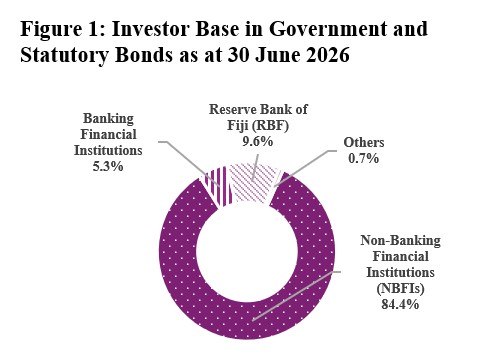
Fiji’s government bonds are primarily purchased by large institutional investors including commercial banks, insurance companies and the superannuation fund, which play a key role in the domestic capital market. In addition, bonds are held by a broader group of investors, including businesses, associations and private individuals, reflecting wider participation in government securities. This structure reflects Fiji’s relatively small but stable investor base.
 What is the RBF’s Role
The RBF plays a key role in ensuring the smooth operation, transparency, and overall stability of Fiji’s bond market. As the official registrar of government debt, the RBF manages and oversees the issuance of government securities, making sure that borrowing plans such as the Government’s annual fiscal‑year financing strategies are carried out efficiently and in line with national debt‑management policies.
In addition to its role as registrar, the RBF serves as the market’s primary source of information. It publishes regular yield curves and bond price lists, providing insights into interest rates, price movements, and broader market conditions. These updates help investors understand the cost of Government borrowing across different maturities. The consistent publication of this data enhances transparency and supports informed decision‑making for both institutional investors and everyday Fijians. Through its combined responsibilities – maintaining the debt registry, supervising government bond issuance and providing reliable market data, the RBF ensures that Fiji’s bond market orderly, credible and accessible to all investors.
Figure 2: Role of RBF in Fiji’s Bond Market
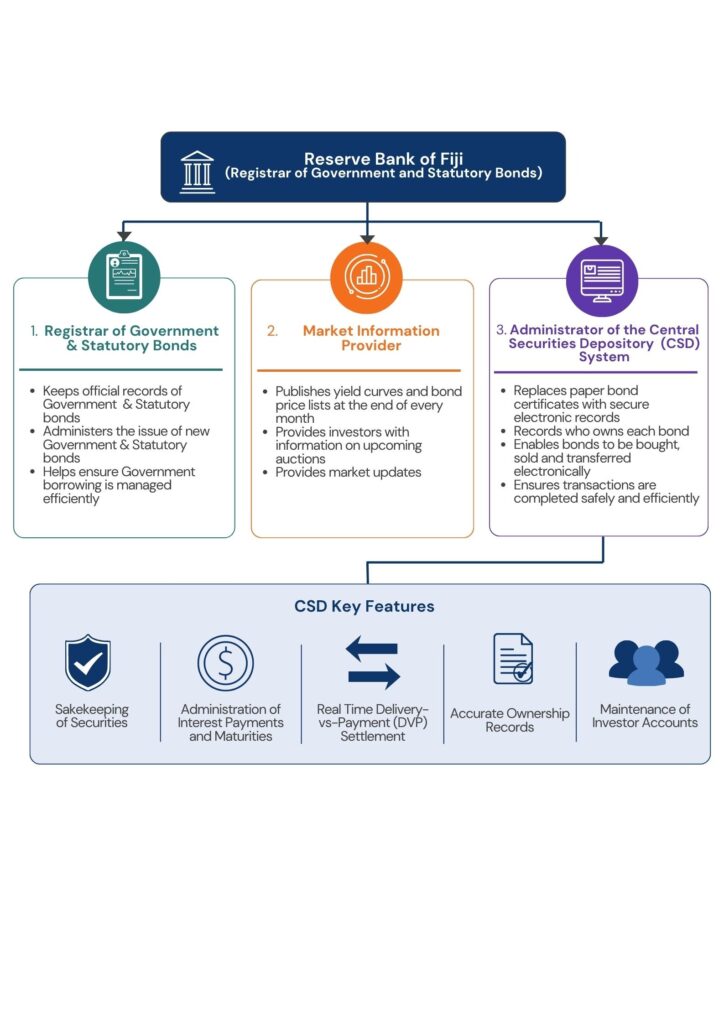
A major recent development is the introduction of a Central Securities Depository (CSD), which marks a significant shift in how government and statutory bonds are issued, held, and traded. Under the CSD, securities are being dematerialised, meaning traditional paper certificates were replaced with secure electronic records. This enables bonds to be recorded, transferred, and settled digitally through the RBF’s CSD platform. As an electronic registry and settlement system, the CSD improves efficiency by enabling real time, delivery‑versus‑payment (DvP) transactions, reducing risks associated with physical documents, and ensuring accurate ownership records. It also provides key services such as safekeeping of securities, administration of interest payments and maturities, and maintenance of investor accounts. Overall, dematerialisation and the CSD modernised Fiji’s bond market by improving transparency, lowering transaction costs and supporting greater participation and liquidity.
The Role of Government in Fiji’s Bond Market
The Fiji Government is the main issuer of bonds in Fiji. Fiji’s bond market is closely tied to the Government’s public debt level which determines the number and value of bonds to be issued.
These borrowing needs directly affect how often bonds are issued, how large the bond issues are, and how they are structured. In response the Government has increasingly issued longer-term bonds, such as 20 year and 25 year bonds to spread out its debt obligations and reduce the risk of refinancing large amounts in the short term. The Government also issues short-term Treasury Bills and bonds with maturities from 3 months to 5 years to cater to different investor appetites.
The Government, together with the RBF, conducts investor relations meetings or stakeholder consultations to determine the tenor and value of the bonds to be issued.
Summary
Fiji’s bond market remains central to financing public investment and supporting macroeconomic stability by providing the Government and statutory corporations with a reliable source of long‑term financing while offering investors stable and relatively low‑risk returns. Although Government securities dominate the market it continues to evolve with the introduction of corporate, thematic and statutory bonds.
Institutions such as the RBF and the Government are central to maintaining market stability, transparency and investor confidence. As Fiji continues to develop its financial system a well‑functioning bond market will remain essential for funding national priorities, deepening capital markets, and promoting sustainable economic growth.
Reserve Bank of Fiji
08 August 2026
DISCLAIMER
The Reserve Bank of Fiji (RBF) wishes to advise the public that all information, articles and materials published or shared by the Bank are intended solely for general informational and educational purposes. The RBF accepts no liability for any loss, damage or inconvenience caused because of reliance on the information contained within these materials.