Press Release No. : 13/2026
Date : 09 June 2026
STATEMENT BY THE CHAIRMAN OF THE MACROECONOMIC COMMITTEE[1] AND GOVERNOR OF THE RESERVE BANK OF FIJI
REVISIONS TO THE MACROECONOMIC PROJECTIONS FOR THE FIJIAN ECONOMY (2025-2028)
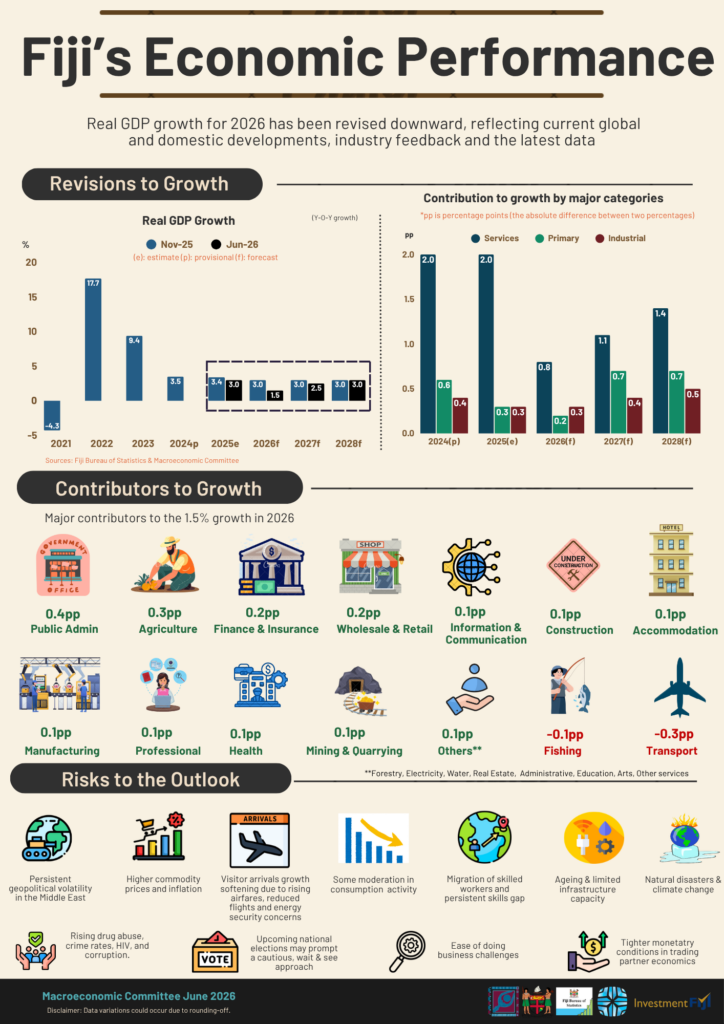
Global risks have risen sharply in recent months, driven by escalated conflict in the Middle East. As a result, oil prices have climbed steeply since February. This has added to an already uncertain global environment shaped by shifting trade policies and geopolitical tensions. In particular, concerns over shipping disruptions through the Strait of Hormuz, a critical route for global oil and fertiliser, have affected economic activity across many sectors. At the same time, rising global prices for food and fertiliser have intensified inflationary pressures and heightened food security risks, particularly for net importing countries such as Fiji. Reflecting these global conditions, the International Monetary Fund in its April World Economic Outlook, lowered its global growth forecast for 2026 to 3.1 percent down from 3.3 percent projected in January.
For Fiji, these global developments continue to be felt through several channels. Higher fuel prices increase production and transportation costs, reduce business profits and output, and raise consumer prices, thereby reducing household spending power. Collectively, these factors are expected to weigh on overall economic activity. Consumer prices have risen sharply in the past few months. Latest data indicate that inflation rose to 3.9 percent in May, a significant turnaround from the -3.8 percent in September 2025. Year-end inflation is now expected to exceed 6.0 percent, underpinned by high imported inflation, particularly through fuel and food prices and its second-round effects.
While remittances inflows registered strong growth so far, recent data on consumption activity is showing signs of easing as households adopt a more cautious approach to spending as they adjust to higher cost of living and rising economic uncertainty. This shift is reflected in the latest Reserve Bank of Fiji Retail Sales Survey, where businesses project retail sales to grow by 2.0 percent in 2026, much lower than the 6.8 percent expected in the August 2025 survey. Moreover, the strong momentum in the tourism sector observed in the first quarter has begun to soften. While visitor arrivals remain supportive of economic activity, the pace of expansion has slowed, weakening one of the key drivers of growth. Based on recent trends in arrivals, forward bookings, reduced flight frequencies, heightened concerns around energy security and tighter monetary conditions in key markets, including Australia, visitor arrivals are now expected to grow at a slower pace than previously anticipated. These factors are expected to dampen private consumption and investment activity, resulting in a slower pace of economic growth in 2026 than previously projected. The duration and severity of the current crisis, and its implications for both the global and domestic economies remain unclear. Therefore, the Fiji economy is projected to grow by 1.5 percent, revised down from the 3.0 percent forecast in November 2025, with downside risks remaining elevated. While Government has announced targeted support measures and is expected to maintain these in the 2026-2027 National Budget, given limited fiscal space, the revised growth outlook assumes that Government expenditure will remain at a similar level. Looking ahead, the economy is forecast to expand by 2.5 percent in 2027, and to converge to its longer-term trend of around 3.0 percent in 2028. Over this period, the services sector, particularly tourism, is anticipated to remain the main driver of growth, supported by contributions from the industrial and primary sectors.
The outlook for Fiji’s external sector remains closely linked to the current global environment, characterised by elevated imported inflation and heightened uncertainty. Higher fuel import costs will lead to a widening of the merchandise trade deficit and result in a larger current account deficit over the forecast period. Nevertheless, the external position remains manageable. The current account deficit is forecast to be financed through adequate foreign reserves, supported by Government external loan drawdowns. As of 09 June, RBF’s foreign reserve holdings stood at around $3.4 billion, enough to cover approximately 4.7 months of retained imports and are projected to remain adequate over the near to medium term.
The Committee will closely assess incoming economic data and global developments, particularly movements in commodity prices and international economic conditions and will revisit these projections toward the end of 2026.
ARIFF ALI
Chairman of the Macroeconomic Committee
[1] The Macroeconomic Committee comprises executive representatives from the Ministry of Finance; Fiji Bureau of Statistics; Ministry of Commerce & Business Development; Ministry of Tourism & Civil Aviation; Ministry of Foreign Affairs & External Trade; Office of the Prime Minister; Investment Fiji; Fiji Revenue & Customs Service and the Reserve Bank of Fiji.
RESERVE BANK OF FIJI
For further details, please contact: –
Communications Office
Telephone: (679) 3223 381 Email: info@rbf.gov.fj
Mr Mervin Singh – Manager Corporate Communications
Telephone: (679) 3223 229 Email: mervin@rbf.gov.fj